
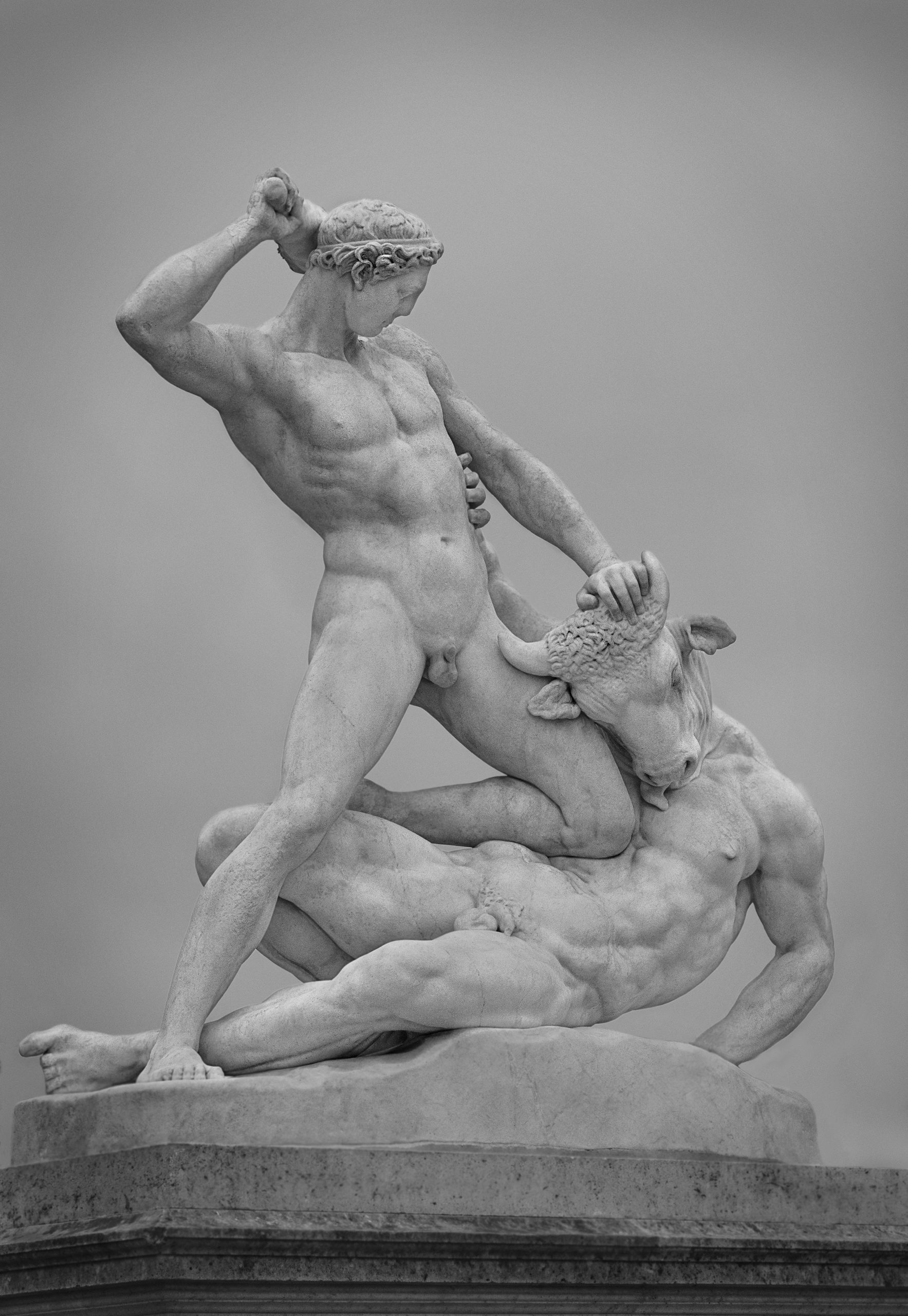
Who Was Theseus? The Myth Explained
Theseus is one of the founding heroes of Greek mythology, best known for defeating the Minotaur inside the Labyrinth at Knossos. But that story is really just the middle chapter of a much longer myth, one that begins with a sword hidden under a boulder and ends with a hero reshaping an entire city. Read on to find out who was Theseus, and the story surrounding him.
The sword and the sandals
Theseus grew up not knowing his father. His mother, Aethra, raised him in Troezen, a small city across the water from Athens. Before he was born, his father, King Aegeus of Athens, had hidden a sword and a pair of sandals beneath an enormous boulder, telling Aethra that if she bore a son strong enough to move the stone, he should carry these tokens to Athens and claim his birthright.
Theseus grew into that strength. As a young man he lifted the boulder with ease, took the sword and sandals, and set off for Athens. Rather than travel by the safer sea route, he chose the dangerous overland road, deliberately walking into a path full of bandits and monsters so he could prove himself along the way. He defeated several notorious villains on that journey, each one a smaller trial before the one that would define him.
Arriving in Athens
When Theseus reached the city, Aegeus didn’t yet recognise his own son. Athens was gripped by a darker problem: every nine years, it was forced to send fourteen young Athenians, seven men and seven women, as tribute to Crete, where they were fed to the Minotaur, a creature with the body of a man and the head of a bull, imprisoned inside a labyrinth built by the master craftsman Daedalus.
Theseus volunteered to be one of the fourteen. Nobody asked him to go. He chose it.
The Labyrinth and the Minotaur
The Labyrinth wasn’t a maze in the garden-hedge-puzzle sense. Daedalus designed it specifically so that no one who entered could reason their way back out. The corridors folded in on themselves until direction itself stopped meaning anything a few turns in.
Before Theseus entered, Ariadne, the Cretan king’s daughter, fell for him and gave him a ball of thread. The idea was simple: tie one end near the entrance, unwind it while walking deeper, and use it to retrace his steps once the Minotaur was dealt with.
Theseus found the Minotaur at the centre and killed it, then followed the thread back out, saving the remaining tributes and ending the cycle of sacrifice for good.
What happened after
The story doesn’t end neatly. Sailing home, Theseus abandoned Ariadne on the island of Naxos, a detail most retellings quietly skip past. In his haste, he also forgot to change his ship’s sails from black to white, the signal he’d promised his father would mean he’d survived. Aegeus, watching from the cliffs and seeing black sails approaching, believed his son was dead and threw himself into the sea, which is where the Aegean Sea takes its name.
Theseus went on to become king of Athens, credited with synoikismos, the unification of the scattered towns of Attica into a single city-state under Athens. It’s a far less famous chapter than the Minotaur, but arguably his most lasting achievement, the moment the myth stops being about one man’s trial and starts being about what he built afterward.
Why the myth still resonates
Strip away the monster and the maze, and what’s left is a story about choosing to walk into something disorienting and dangerous, carrying nothing but a single thread tying you back to who you were before you went in. That’s the part of the myth that outlasts the plot itself. Not the fight, but the fact that finding a way back out mattered just as much as facing what waited inside.
It’s also, quietly, a story about someone who came out changed. Theseus who entered the Labyrinth and Theseus who founded a unified Athens aren’t quite the same person, one fought a monster, the other built something lasting from scattered pieces. The thread didn’t stop that change from happening. It just meant he never lost hold of himself while it did.
That’s the version of the myth worth remembering, not a monster story with a hero and a maze, but a story about walking toward the thing everyone else avoided, and finding your way back changed rather than lost.

5 Comments