Who Are The Great Greek Heros?
Greek mythology gave us a whole cast of heroes, but a handful stand above the rest. They’re the ones whose names survived thousands of years, whose stories still get retold on cinema screens and in classrooms. What’s easy to miss is how different they are from one another. Some are defined by raw strength, some by cunning, some by the simple decision to walk toward the thing everyone else ran from. Here are six of the greatest, and what each one came to represent.
Theseus
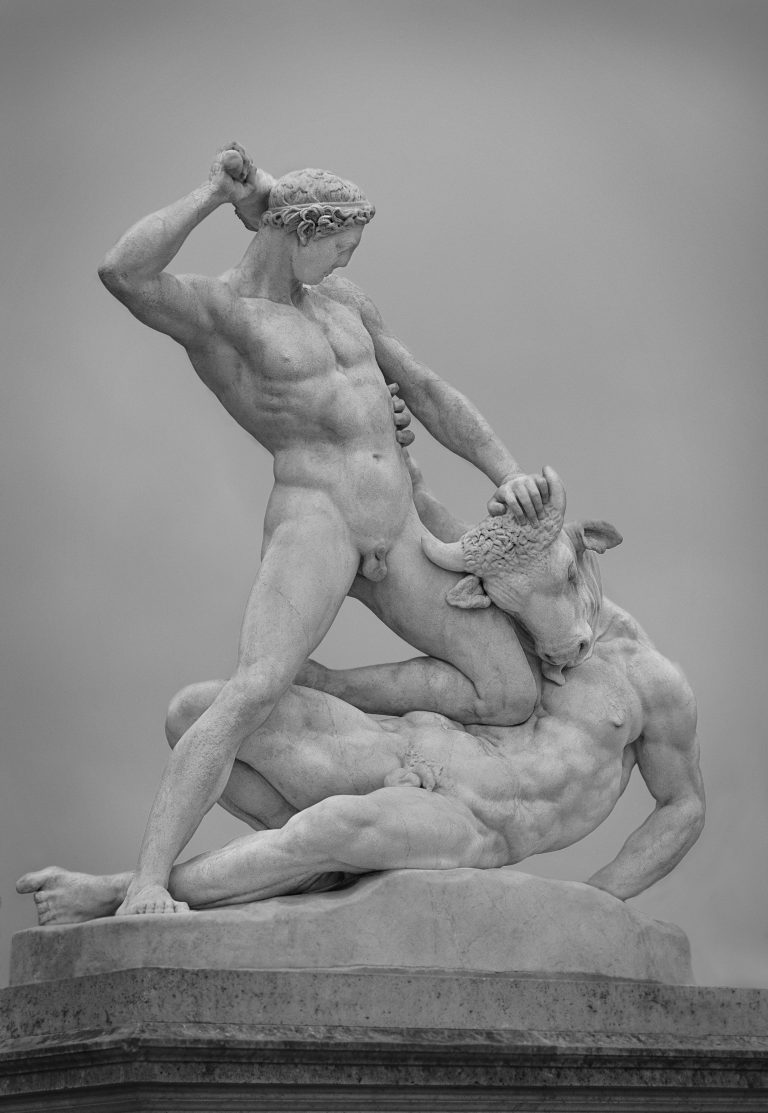
Theseus is the Athenian hero best known for entering the Labyrinth to face the Minotaur, the creature waiting at the centre of a maze built so cleverly that no one who entered could find their way out, and who our brand is built around.
The context is grim. Every nine years, Athens was forced to send fourteen young people, seven men and seven women, to Crete as tribute, where they were fed to the Minotaur. Theseus volunteered to be one of them. Nobody made him go. He decided that ending the cycle was worth walking into the one place designed to break anyone who entered it.
What makes his story distinct isn’t the fight. It’s the thread. Before he went in, Ariadne gave him a ball of string to unwind behind him, so he could retrace his steps and find his way back out. The thread didn’t fight the Minotaur for him, and it didn’t know the way through the maze. It simply kept a line back to where he’d started. His myth isn’t really about defeating a monster. It’s about choosing to face something disorienting, and having something that keeps you connected to who you were while you’re inside it.
Before he even reached this point, Theseus had already made a habit of choosing the harder path. On his journey to Athens to claim his birthright, he took the dangerous overland road rather than the safe sea route, deliberately taking on the bandits and monsters along the way. Later he became king of Athens, credited with uniting the scattered towns of the region into a single city. But it’s the Labyrinth that endures, because it captures something the others don’t: the courage to walk toward the centre of the maze on purpose, and come out the other side changed but still yourself.
Heracles
Heracles, known to the Romans as Hercules, is the most famous and most physically powerful hero in all of Greek mythology, the definition of raw, overwhelming strength.
The son of Zeus and a mortal woman, he was hated by the goddess Hera from birth. Her hatred eventually drove him to a terrible act committed in a fit of madness, and to atone for it he was sentenced to complete a series of near-impossible tasks for King Eurystheus. These became the Twelve Labours, the feats that define him.
The labours read like a catalogue of the impossible. He killed the Nemean Lion, whose hide no weapon could pierce, and afterward wore its skin as armour. He destroyed the many-headed Hydra, which grew two heads for every one severed. He cleaned the Augean stables, filled with years of filth, in a single day by rerouting a river through them. He captured monstrous beasts, retrieved golden apples from the edge of the world, and in his final and most daunting task, descended into the underworld itself to bring back Cerberus, the three-headed dog guarding the dead.
What sets Heracles apart is that his heroism is bodily and physical. Where other heroes think or choose their way through, he endures and overpowers. His strength is almost divine, but his story is also deeply human: a man paying, over and over, for a moment of madness, trying to make himself right through sheer effort. He is the hero as force of nature.
Perseus
Perseus is the hero who killed Medusa, the Gorgon whose gaze turned anyone who looked at her to stone. His story is one of cleverness paired with divine help, rather than brute strength.
Sent on what was meant to be a suicidal errand, to bring back the head of Medusa, Perseus was aided by the gods. He received winged sandals to fly, a cap of invisibility, a mirrored shield, and a blade sharp enough to do the job. The mirrored shield is the key detail: rather than look at Medusa directly and be turned to stone, he watched her reflection, and beheaded her while she slept without ever meeting her eyes.
The victory kept giving. Medusa’s severed head retained its petrifying power, and Perseus used it as a weapon afterward, most famously to rescue Andromeda, a princess chained to a rock as a sacrifice to a sea monster. He turned the monster to stone and married her.
Perseus represents the hero who wins through wit and preparation as much as courage. He doesn’t overpower Medusa; he outthinks the problem she poses. The image of the young man refusing to look directly at the thing that could destroy him, facing it instead through a reflection, is one of the most enduring in all of Greek myth.
Achilles
Achilles is the greatest warrior of the Trojan War, the central figure of Homer’s Iliad, and the embodiment of martial glory and its terrible cost.
As an infant, according to later tradition, he was dipped by his mother into the River Styx to make him invulnerable. But she held him by the heel, and that one spot, untouched by the water, remained his single point of weakness. It gives us the phrase “Achilles’ heel” to this day.
At Troy, Achilles was unmatched on the battlefield, but his story is as much about pride and rage as it is about skill. Much of the Iliad turns on his anger: insulted by the Greek commander Agamemnon, he withdraws from the fighting, and the Greeks suffer terribly in his absence. Only when his closest companion Patroclus is killed does he return, consumed by grief and fury, to take his revenge on the Trojan hero Hector.
Achilles knew, through prophecy, that his fate was sealed: he could live a long, quiet, forgotten life, or a short one that would make his name immortal. He chose glory over length of days. That choice is what makes him tragic. He is the hero who trades everything for a name that outlives him, and the arrow that finally strikes his heel proves that even the greatest warrior carries a fatal vulnerability.
Odysseus
Odysseus, King of Ithaca, is the hero of Homer’s Odyssey and the great counterpoint to heroes like Heracles and Achilles. His weapon isn’t strength; it’s cunning, what the Greeks called metis, a sharp and adaptable intelligence.
His story is one of homecoming. After the ten-year Trojan War, Odysseus spends another ten years trying to return home to his wife Penelope and son Telemachus, twenty years away in total. The journey throws everything at him: the man-eating Cyclops Polyphemus, the enchantress Circe, the deadly song of the Sirens, the sea monsters Scylla and Charybdis, and years of delay on the islands of Circe and Calypso.
He survives by his mind. Trapped in the Cyclops’s cave, he tells the creature his name is “Nobody”, so that when he blinds him and the Cyclops cries for help, the other giants hear only that “nobody” has hurt him. It’s a perfect example of how Odysseus works: he thinks his way out of situations no amount of strength could solve.
But his story carries a quiet complication. Odysseus sometimes gets in his own way, lingering where he should press on, and his own pride occasionally lengthens his suffering. His journey is a nostos, a homecoming, and it gives us the word nostalgia. He represents the hero defined not by muscle but by resilience, adaptability, and the deep human pull toward home.
Jason
Jason is the hero who led the Argonauts on the quest for the Golden Fleece, a story of a hero as leader, assembling the greatest figures of his age for a single voyage.
His tale begins with a stolen throne. Jason’s uncle Pelias had seized the kingdom that was rightfully Jason’s, and an oracle had warned Pelias to beware a stranger wearing a single sandal. When Jason arrived at court having lost one sandal crossing a river, Pelias, alarmed, set him an impossible task to be rid of him: retrieve the Golden Fleece from the distant land of Colchis, at the far edge of the known world.
Jason gathered a crew of heroes, the Argonauts, named for their ship the Argo, and among them, in many tellings, were figures like Heracles and Orpheus. Together they endured a long and perilous voyage. On reaching Colchis, Jason faced tasks no man could complete alone: yoking fire-breathing bronze bulls, sowing a field with dragon’s teeth, and fighting the armed warriors that sprang up from them. He succeeded only with the help of Medea, the king’s daughter, a powerful sorceress who fell in love with him and used her magic to help him seize the Fleece.
Jason’s heroism is different again. He isn’t the strongest or the cleverest in his own story; often those around him are more formidable. His gift is that he draws great people together and leads them toward a shared goal. But his myth also carries a darker turn, his later betrayal of Medea leads to tragedy, a reminder that in Greek mythology, even triumphant heroes rarely escape a reckoning.
Six heroes, six kinds of greatness
What’s striking about these six is how little they have in common beyond the title of hero. Heracles overpowers. Perseus outwits. Achilles burns bright and brief for the sake of glory. Odysseus endures and adapts his way home. Jason leads. And Theseus walks willingly into the maze, holding a thread that keeps him tied to himself.
That range is part of why Greek mythology has lasted. It never settled on a single idea of what makes someone heroic. Strength, cleverness, glory, resilience, leadership, and courage each get their own figure, their own story. Taken together, they map out most of the ways a person can face what’s in front of them, which is exactly why, thousands of years later, we’re still telling their stories.